Chapter 3
The Hierarchy
So you have your Lens. You have your Compass.
But here's the thing: you don't just have one of each.
You have a version of everything. Part of you sees abstract patterns. Part of you tracks physical reality. Part of you demands logical coherence. Part of you monitors social harmony.
If all of these tried to run at full volume simultaneously, you'd be catatonic. Every decision would involve an internal committee meeting that never adjourns.
So your psyche does something clever. It organizes them into a hierarchy.
Some of these ways of seeing and evaluating have permission to drive. Others only speak when spoken to. And one is locked in the basement, making noise you'd prefer to ignore.
This architecture isn't ours. It goes back to Carl Jung, expanded by a theorist named John Beebe. We're just translating it into language you can feel your way through.
Permission, Reps, and the Talent Illusion
Before we get to the hierarchy itself, I need to explain what "permission" actually means here.
It's not abstract. It's not metaphorical. It's something you can feel.
When a part of your cognition has permission, using it feels effortless. Natural. You don't have to try. You don't have to warm up. It's just... available. All the time.
And here's the thing about having something available all the time: you use it all the time.
Which means you accumulate reps. Thousands of them. Tens of thousands. From childhood onward, you're practicing this particular way of processing reality, over and over, while barely noticing you're doing it.
And what happens when you get tens of thousands of reps at something?
You get good at it.
This is the talent illusion. What we call "natural talent" might just be "permission to overuse a particular cognitive lane." You're not born magically good at pattern-recognition or logical analysis or reading social dynamics. You're born with a brain that gave one of those lanes more permission than the others. So you drove in that lane constantly. And now you're skilled.
Permission → reps → skill.
And permission isn't only internal. Sometimes it comes from your culture saying "boys are good at logic" or "girls are good at empathy." Sometimes it comes from what your school reinforces, what your family rewards, what your neighborhood will tolerate. You get reps where you're allowed to play. A kid who gets told "don't be so emotional" learns to rep logic instead. A kid who gets told "don't be so bossy" learns to rep harmony. The hierarchy isn't built in a vacuum. The world has opinions about which lanes you're permitted to drive in, and those opinions aren't distributed equally.
But there's another dimension too: certainty.
When you've used something that many times, you develop a felt sense of trust in it. You know it works. You don't question whether you're doing it right. The certainty is bone-deep, built from a lifetime of evidence.
This is what the hierarchy is actually made of. Not just "which capacities you have" - everyone has all of them - but which ones carry permission, which ones you've repped, which ones you trust.
And which ones still feel like foreign territory no matter how many times you visit.
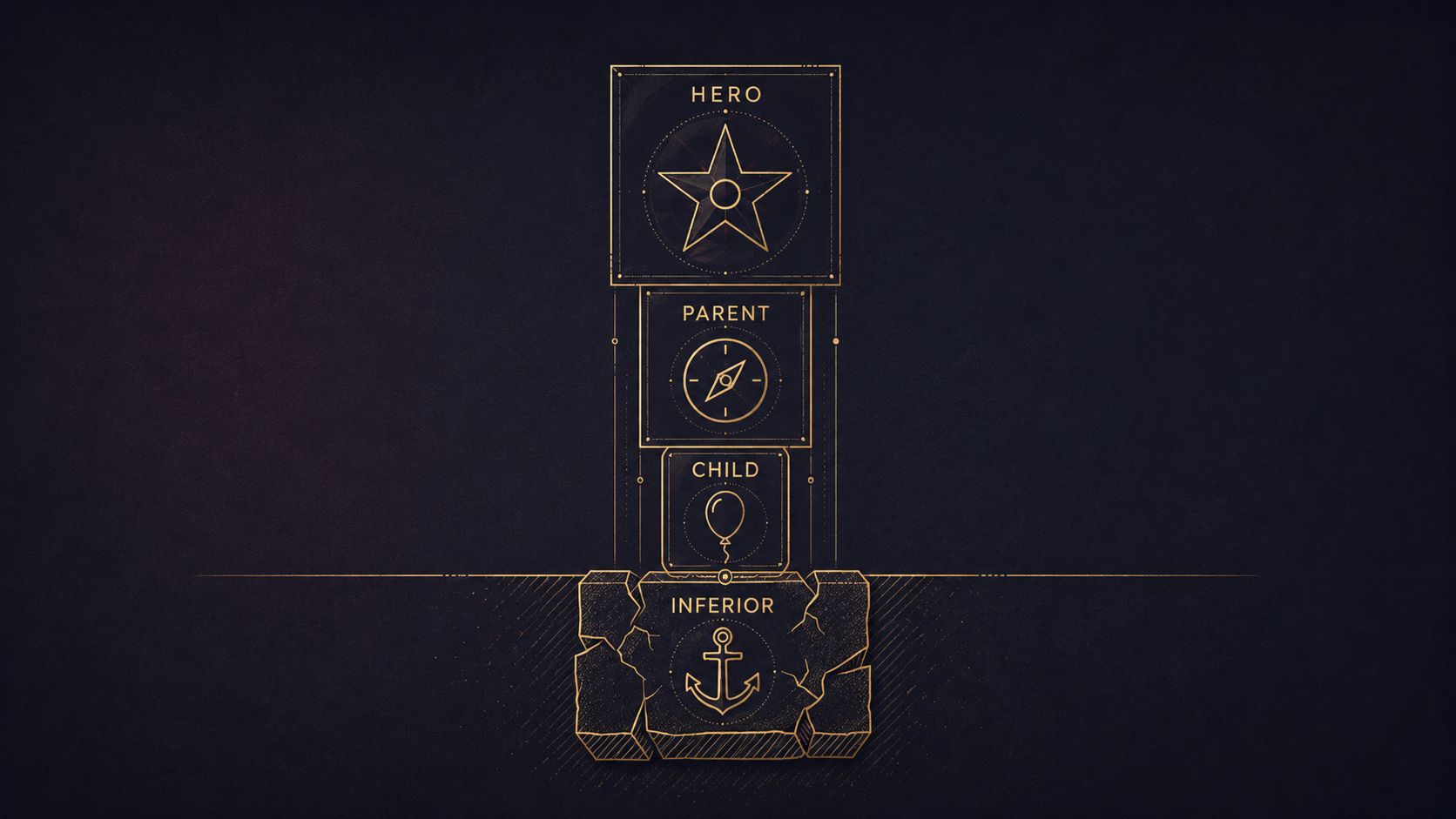
The Dominant (Your Main Character)
We're going to call this the Hero, even though that sounds grandiose.
It sounds grandiose because it kind of is. This is your main character. The function that runs so constantly, so effortlessly, that you usually don't notice it's a function at all.
Fish don't notice water. You don't notice your dominant.
To you, it's not a "way of processing." It's just... reality. How things obviously are. The self-evident truth that somehow everyone else keeps missing.
If your dominant is logical coherence-checking, you don't think "I'm good at logic." You think "why is everyone else so comfortable with contradiction?"
If your dominant is tracking social dynamics, you don't think "I'm good at reading people." You think "why is that guy being so obviously oblivious to what he's doing?"
The dominant assumes it is the authority. It doesn't ask permission. It doesn't wonder if it's right. It just operates, with a kind of baseline confidence that can look like arrogance from the outside - but from the inside feels like just... seeing clearly.
Here's what it feels like for me:
My dominant is internal logical coherence. When I encounter new information, I don't just receive it - I'm checking it against everything else I think I know. Does it fit? Does it contradict something? Is the structure sound?
This happens automatically. Constantly. I can't turn it off. When someone says something that doesn't quite cohere, I feel it - physically feel it - before I consciously identify what's wrong.
And I trust this sense completely. Not arrogantly, not "I'm always right" - but in the way you trust your vision. You don't walk around wondering if the walls are really there. You just see them. That's how I experience logical coherence. It's just there, obvious, load-bearing, not up for debate.
That's what permission feels like at the dominant level. Total. Implicit. Beyond question.
Someone whose Hero is the Thermostat experiences this same certainty about social dynamics. They walk into a room and know the tension between those two people is about to become everyone's problem. They don't analyze it. They don't decide to notice it. It's just obvious. Like seeing a wall.
The trap, of course, is that this certainty doesn't mean you're actually right. It just means you're confident. Those are different things. But they don't feel different from the inside, which is why dominant functions make people arrogant in their particular flavor.
The Auxiliary (Your Responsible Adult)
We're going to call this the Parent.
If the Hero is who you are without effort, the Parent is what you become when you're trying to be useful.
This one doesn't feel like flow. You engage it most naturally when you need to be responsible, when you're helping someone, or when you're translating your Hero's insights into something the world can actually use.
Where the dominant runs with unconscious and implicit permission, the auxiliary runs with conscious permission. You know you're doing it. It takes more energy. But it's still accessible - still skilled, still trusted.
The certainty here is real but humbler. The auxiliary knows it's good at what it does. But it also knows its limits. It doesn't have the bone-deep "this is just how reality is" confidence of the dominant. It's more like "I've developed this, I trust it, but I hold it a bit more loosely."
For me, this is possibility-generation. Making connections between ideas, seeing what could be, exploring implications. It doesn't run automatically the way coherence-checking does. I have to engage it. But when I do, it works.
And I've worked on it. A lot. I've deliberately practiced holding multiple possibilities open, resisting the urge to collapse into one answer too quickly. The skill is real, but it's built skill, not the effortless kind.
This is the function to develop if you want to grow. Seriously. The auxiliary is the most mature, measured perspective you have access to. When the dominant gets obsessive or the lower functions get defensive, the auxiliary is the adult in the room saying "okay, let's actually think about this properly."
Here's an important tidbit about how the Parent comes online:
It activates naturally when you're helping others. Using it for yourself requires conscious effort.
Watch what happens when a friend brings me a problem.
I slip into my Parent almost automatically. Suddenly I'm generating possibilities, offering options, seeing angles they haven't considered. "What if you tried this? Or this? Have you thought about approaching it from this direction?"
That's my Parent function doing its thing. Helpful. Generative. Measured. It comes online without me forcing it.
But when I'm stuck? When I'm the one in a rut?
Different story. At least without the conscious training I've put into this.
Naturally, my Hero will happily analyze the problem forever. The third-position function (we'll get there in a minute) will offer reasons why change is risky and staying put is sensible. And if I'm not careful, I'll spin for hours, feeling like I'm thinking but not actually getting anywhere.
The move - the growth move - is to turn the Parent inward.
To ask: "What would I tell a friend in this situation?"
And then actually listen.
This sounds simple. It isn't. There's a weird resistance to giving yourself the same quality of support you'd naturally give someone else. But the capacity is there. The skill is there. You just have to redirect it.
One more thing about the Parent, and this is important:
It faces a different direction than your Hero.
Here's what I mean. If your Hero works mostly inside your head - building models, checking values, running internal simulations - your Parent works mostly outside it. In the world. With people, with action, with reality you can touch.
And vice versa. If your Hero is externally focused, your Parent turns inward.
They balance each other. They complement. The Parent offers perspective your Hero structurally can't have, because it's looking somewhere else.
This is why engaging your Parent is the primary growth lever. Not because it's your strongest function - it isn't. But because it's your most mature function, and it naturally corrects for whatever your Hero is overdoing.
When I get stuck in internal analysis, my Parent says: "Okay, but what could we actually do with this? What are the options? Let's explore instead of just verify."
Take someone whose Hero is external group harmony - always scanning the room, always managing the relational field. When they get stuck in constant accommodation, their Parent might say: "Okay, but what actually happened before? Let's check this against what we know instead of reacting to what we feel right now."
That's their Archive - their stored experience - pulling them out of the reactive loop and grounding them in something stable.
The Parent is the adult in the room. And learning to activate it for yourself - not just for others - is most of what cognitive self-development actually is.
The Tertiary (Your Inner Child)
Here's where things get messier.
We're calling this the Child, and that's not just cute naming. It actually behaves like one.
The Child sits in the third position. It has some permission, but not much. It's developed enough to be accessible, but not enough to be reliable.
And it wants gold stars.
Where the Hero operates with implicit certainty and the Parent operates with humble confidence, the Child operates with something I'd call defensive certainty.
It wants to feel capable. It wants to believe it's good at this. But underneath that wanting is a shakiness. A neediness. A "please tell me I'm doing this right" energy that the Hero would never have.
You can feel the difference. The Hero doesn't need external validation of its outputs. It just knows. The Child kind of needs that validation, or it gets wobbly.
Here's another thing about the Child: it faces the same direction as your Hero.
Where the Parent complements the Hero by looking somewhere different, the Child agrees with the Hero about where to look. They're both oriented the same way. Both focused inward, or both focused outward.
This creates a natural affinity. A gravitational pull. The Hero and Child speak a similar language in a way the Hero and Parent don't.
That sounds nice. It isn't.
Because that affinity creates a trap. One that feels like thinking but isn't.
The Loop
If you're already familiar with this model whatsoever, you've probably heard of cognitive "loops" - those stuck states where someone keeps cycling between two functions without accessing the others.
The standard explanation is that the Hero recruits the Child into an echo chamber. The Hero runs wild, the Child validates it, and the Parent gets ignored.
That's half the story.
What actually happens is more like a conspiracy. The Child's anxiety provides the emotional fuel. The Hero provides the sophisticated rationalization. Which one "starts" it matters less than the structure: Hero and Child are in cahoots, the Parent is offline, and nobody's asking the uncomfortable question.
In practice, it often runs from the bottom up.
The Child has an emotional reaction. Then it recruits the Hero to rationalize that reaction.
Let me make this concrete.
You're miserable in your job. Not "mildly dissatisfied" miserable. The kind of miserable where Sunday evenings feel like a slow-motion car crash. You fantasize about quitting in the shower. You've Googled "career change at 34" more times than you'd admit.
But you haven't done anything about it.
Here's what's happening under the hood.
Your Child - the comfort-and-safety function - feels the danger first. Not as a thought. As a body sensation. A tightening. Leaving means the unknown. The unknown means risk. Risk means you might lose the apartment, the routine, the health insurance. The Child doesn't analyze this. It just grips. "Stay. Stay where it's mapped. At least we know what this pain feels like."
That's not logic. That's a survival reflex wearing the costume of prudence.
But watch what happens next.
Your Hero - logical coherence - gets recruited to build the case.
"Well, if you think about it, the job market volatility index isn't great right now. Statistically, most career changes result in a short-term pay cut. The expected value calculation, factoring in loss of benefits, seniority, and network effects, clearly favors staying. It would be imprudent to leave without at least eighteen months of runway, which we don't have, so really the rational move is to wait."
Sounds pretty logical, right?
It isn't.
It's your Hero in service of your Child's defensive emotional reaction. The logic came second. The feeling came first. Your strongest function got conscripted to justify what your least mature function already wanted.
So you stay. For another year. Then another. Then three. The analysis gets more sophisticated each time - more data points, more caveats, more reasons this isn't the right moment. And the whole time, you're burning out. Slowly. Thoroughly. The kind of burnout that doesn't announce itself until you're sitting in your car in the parking lot unable to make yourself open the door.
This is why loops are so hard to catch. You feel like you're being rational. Your Hero is running. You're producing coherent analysis. But the analysis is pointed at a conclusion that was already determined by something much less mature.
The Hero becomes a sophisticated lawyer for the Child's preschool-level fears.
And because they face the same direction - because they speak the same language - the collaboration is seamless. The Parent would ask uncomfortable questions. "What if we just applied to one place? Just to see? What if the market isn't as bad as we've decided it is? What if staying is actually the riskier move?" But the Parent faces a different direction. It takes effort to engage. And when you're already looping, you don't want to make that effort.
You want to stay in the comfortable space where your Hero and Child agree that everything is fine, actually.
Breaking a loop isn't about "trying harder" with your Hero. That digs the hole deeper.
Breaking a loop is about activating your Parent. Turning to that different-direction perspective and genuinely asking: "What would I tell a friend in this situation?"
Then noticing that you'd tell them to update their resume tonight.
How to Know You're Looping
The tricky thing about loops is they feel like thinking. They have the texture of rationality. You're using your best function. The analysis is sophisticated. The conclusions seem sound.
But you can learn to catch them. Three markers.
1. The conclusion feels relieving, not true.
There's a difference between arriving at an answer that's accurate and arriving at an answer that makes the anxiety stop. A real conclusion can be uncomfortable. It can point toward something you don't want to do. A loop conclusion almost always points toward inaction, comfort, the known. If your "analysis" consistently lands on "do nothing and feel better about it" - that's not analysis. That's anesthesia.
2. You've been here before.
Same thoughts. Same sequence. Same conclusion. Same inaction. If you can predict the entire chain of reasoning before it finishes - because you've run it forty times - you're not thinking. You're replaying. Thinking produces new information. Looping produces the same information with increasing conviction.
3. A voice is missing.
This is the structural tell. In a loop, the Hero and Child are talking. The Parent is not. You can check for this directly. Ask yourself: "Am I avoiding checking this against something outside my own head?" Or the reverse: "Am I avoiding checking this against what I actually feel inside?" Whichever question makes you flinch - that's the direction your Parent faces. And that flinch is the sound of the door you've locked it behind.
The Inferior (Your Basement Dweller)
And finally, the one in the basement.
I don't have a cute name for this one. Let's just call it what it is: the Inferior. The lowest. The least developed. The thing your psyche locked away to become who you are.
Your Inferior is the structural opposite of your Hero. Whatever your Hero prioritizes, your Inferior is the thing that got sacrificed to make that prioritization possible.
If your Hero is internal logical coherence, your Inferior is external social-emotional attunement.
If your Hero is external effectiveness, your Inferior is internal holistic meaning.
If your Hero is tracking group harmony, your Inferior is following your own internal logic regardless of the group.
Whatever you built your identity around, the Inferior is what got traded away.
And it feels like it.
Using your Inferior is clunky. Exhausting. Unreliable. Twenty minutes of sustained effort there and you need a nap. You feel like an imposter. Like a kid wearing adult clothes.
But here's the worst part:
You're never certain you did it right. Even when you did.
Remember the certainty gradient? Hero has total implicit certainty. Parent has humble confidence. Child has defensive certainty that wants validation.
The Inferior has almost no certainty at all.
I can objectively nail a social-emotional moment. I can say the right thing, read the room accurately, attune to what someone needs. And afterward?
There's still a whisper. "Was that weird? Did I overdo it? Did they notice I was trying?"
That whisper is the Inferior's signature. You can build skill there - slowly, expensively - but you will never feel fully settled. The nagging "am I doing this wrong?" doesn't go away with practice. It's structural.
This is why Inferior encounters often feel like shame. You're exposing the part of yourself that's least developed, least certain, least defended. And some part of you knows it.
But there's another side to the Inferior. It's not just your weakness. It's also, weirdly, where some of your most earnest caring lives.
The Inferior tends to operate like a binary (on/off) switch. Usually off. Your Hero and Parent and Child are having their conversations, making their contributions, and the Inferior just... isn't compulsively consulted. It doesn't chime in as much. It's not part of the regular rotation.
Then something specific triggers it, and suddenly it spikes to very important.
Not dramatic. Not a meltdown. Just... this one thing matters. A lot. In a way you can't fully articulate.
Say your Hero is internal logical coherence - the Blueprint. Your Inferior is social-emotional attunement. You don't walk around tracking group harmony. It's not your game.
But somewhere along the way, something got imprinted. Maybe a lesson that landed hard. And now you have this thing about, say, being kind to waiting staff at restaurants.
You watch someone be rude to a server and feel genuinely bothered. Not in a complex, analytical way - in a surprisingly simple way. "You're supposed to be nice to them." It's almost childlike. And it's completely sincere.
Or say your Hero is the Web - possibility and connection, always branching outward. Your Inferior is the Archive - stability, the known, the way things have been. You don't care much about tradition or routine. Except for that one mug. Or that one blanket. Or that one memory from childhood that you protect with unexpected ferocity.
Everything else in that domain? Negotiable. That specific thing? Non-negotiable.
Or say your Hero is the Thermostat - group harmony, social attunement, making sure everyone's okay. Your Inferior is the Blueprint - internal logical consistency. You don't sit around building mental models for fun. But you have this one position - maybe about fairness, maybe about how a particular system should work - where your logic is surprisingly precise and absolutely immovable.
You can't articulate why it matters so much. You just know the math doesn't add up, and you won't let it go.
This is the Inferior's other face. Not just clumsy and shame-prone. Also the keeper of a few things you care about with disproportionate, uncomplicated sincerity.
The stuff your more sophisticated functions would probably talk you out of caring about, if the Inferior let them near it.
The Grip
So what happens under extreme stress?
When you're exhausted. Overwhelmed. Pushed past capacity.
The Hero gets tired. The Parent checks out. The Child hides.
And the Inferior kicks down the door.
This is called the Grip. It's a Jekyll and Hyde moment. You start acting out the worst, most primitive version of the exact thing you've spent your whole life avoiding.
If your Hero is internal logical analysis (The Blueprint)?
Under grip, you experience what I'd call Desperate Connection. The logic has failed. Every framework, every model, every carefully built structure - none of it is holding. And underneath all that architecture, there's a human animal that needs its tribe. So you reach. Clumsily. You become convinced everyone hates you. Neutral silences become evidence of abandonment. You catastrophize, you spiral, you make bids for reassurance that your normal self would find mortifying. It's not an "emotional disaster." It's a desperate bid for love, executed by the part of you least equipped to ask for it.
If your Hero is internal pattern-recognition (The Telescope)?
Under grip, you become obsessively physical. The vision has collapsed. The trajectory you were so sure about has disintegrated, and without it you're unmoored - a person who always knew where things were going, suddenly with no idea where they are. So you grab for the concrete. You eat past fullness, not tasting anything, just needing the sensation of something solid. You spend money on things you don't want. You binge on stimulation - shows, scrolling, anything that fills the space where the meaning used to be. It's not indulgence. It's drowning yourself in concrete input because the abstraction has failed and you need to feel the floor.
If your Hero is external group harmony (The Thermostat)?
Under grip, you experience what I'd call Ruthless Truth. The harmony has failed. You've been absorbing, accommodating, smoothing things over - and it hasn't worked. So the system flips. Suddenly you're stating every brutal fact you've been suppressing for years. You list the fourteen precise reasons someone has failed you. Cold. Surgical. Devastating. It's not "weaponized logic." It's a bid for reality, executed by the part of you that has been biting its tongue so long it forgot it had teeth.
If your Hero is internal value-alignment (The Tuning Fork)?
Under grip, you become compulsively productive. The values have failed. The thing you stood for didn't hold, the integrity you organized your life around cracked, and without it you don't know who you are. So you do. You organize closets. You make lists. You throw yourself into tasks that have nothing to do with what's actually wrong - because at least shipping something feels like existing. It's not efficiency. It's a desperate bid for ground, executed by the part of you that measures worth in output rather than meaning.
The Grip feels terrible. It's embarrassing. You look back afterward and think "that wasn't me."
But it serves a purpose.
It forces you to acknowledge the part of reality your Hero has been systematically deleting.
The logical analysis person does have social-emotional needs. The desperate reaching proves it.
The pattern-recognition person does live in a physical body. The desperate grasping for sensation proves it.
The harmony person does have independent opinions that exist apart from the group. The ruthless honesty proves it.
The Grip isn't dysfunction. It's a smoke alarm. Something has been ignored too long, and now it's screaming.
Both Versions Are Real
I need to introduce a principle here that's going to matter throughout this book.
When you're in a grip, you don't feel like yourself. You look back afterward and think "that wasn't me." Your friends, if they witnessed it, might say "I've never seen you like that."
But it was you.
Same person. Same nervous system. Different activation state.
We want to believe there's a "real self" - probably the one we prefer - and the other versions are aberrations. Not really us.
They are.
Your regulated self is real. Your dysregulated self is also real. Your Hero running smoothly is real. Your Inferior erupting under stress is also real. Neither is fake. Neither is performance. They're both you, expressing differently under different conditions.
This matters for two reasons:
First, for self-compassion. If your grip state is "not really you," then you can avoid examining it. You can treat it as a glitch rather than information. But if it's genuinely you - a version of you that emerges under specific conditions - then you can get curious about it. What does this version need? What is it trying to protect? What would help it show up less often?
Second, for understanding others. The person you love has multiple versions too. The one you fell in love with and the one who drives you crazy aren't contradictions. They're the same nervous system under different loads. Neither is the "real" them while the other is fake.
We'll return to this principle repeatedly. It applies to everything we're going to cover - survival strategies, attachment patterns, developmental levels, state fluctuations. In each case, the temptation is to identify the "good" version as authentic and dismiss the other.
Resist that temptation.
Both versions are real. Understanding which conditions produce which version is more useful than arguing about which one is "truly" you.
The Shape of Development
Okay. Now that we've met all four, let me tell you something about how they work together.
You might think the goal is to develop your Inferior. To attack that weakest point head-on until you're finally good at it.
That doesn't work.
The Inferior is too energetically expensive. Too shame-laden. Too volatile. Direct assault just triggers more Grips.
The actual development path is sneakier.
You develop through your Parent.
Your Parent creates contexts where the Inferior can get gentle, incidental exposure.
For me, this looks like putting myself in exploratory, playful social situations. My Parent - possibility-generation - can handle the social context. It gives me something to do, something to riff on, something to offer. And while the Parent is running the show, my Inferior - social-emotional attunement - gets to practice. Quietly. In the background. Without the full spotlight of "now perform your worst function under pressure."
I don't develop social-emotional skills by attacking them directly. I develop them by being present in Parent-led contexts where those skills get incidental reps.
The Parent is the container. The safe space. The thing that lets you stretch toward your weakest point without triggering a full defensive collapse.
This is why I said earlier that the Parent is the primary growth lever.
Not because it's your strongest function. Because it's your most mature one. Because it faces a different direction than your Hero. And because it can hold space for development that would overwhelm you if you tried to do it alone.
As you can imagine, this looks very different for different configurations. The specifics come later.
For now, we're just laying out the map.
The Stack as Self
One more thing before we move on.
This hierarchy isn't just a description of your cognitive preferences. Over time, it becomes something more like identity.
Your Hero is who you are - or at least who you experience yourself as being.
Your Parent is who you become when you're at your best, helping yourself or others.
Your Child is where you retreat when you want relief from the demands of being the Hero all the time.
Your Inferior is your shadow - the part you'd rather not acknowledge, the part that emerges when you can't hold it together anymore.
That's not just cognitive architecture. That's a self.
Understanding how that self is structured - where it's strong, where it's fragile, where it defends, where it can grow - is the foundation for everything else we're going to build.
Because this is only Dial One.
We haven't talked yet about what your nervous system learned to fear when you were four years old. We haven't talked about what happens when someone gets close enough to matter. We haven't talked about the complexity of world you can actually hold, or how all of this shifts when you're sleep-deprived and hungry.
The Cognitive Dial is just the operating system. The other dials determine what software gets run on it, and why, and when.
Chapter 4 gives you the technical vocabulary. Shows you how Lenses and Compasses combine into specific types. Then we move to the Safety Dial, where things get less abstract and more personal.