Chapter 1
The Lens
Imagine you're standing in a crowded airport terminal.
Next to you is your friend Dave.
You and Dave are physically in the same space. Photons hitting your retinas in the same configuration. Sound waves vibrating your eardrums at the same frequency.
You are not in the same world.
If you ask Dave what's happening right now, he goes into tactical mode: "This line is a disaster. If they opened that second lane and stopped with the pointless ID checks, throughput would increase by 40%. We have 18 minutes until boarding. If the person in front of us doesn't have PreCheck, we're going to miss the zone 1 call."
Dave is running a filter that prioritizes systems, logistics, execution. He's living in a world made of clocks and bottlenecks.
If you ask me what's happening, I probably won't hear you at first.
I'm staring at the plastic bins.
"You know, it's wild that we've normalized the ritual of taking off our shoes. This is basically a secular baptism. We shuffle forward, disrobe slightly, place our offerings in the grey plastic altar, and pass through the scanner to be judged worthy of flight. Look at that guard's posture - he's standing exactly like a bored Roman centurion. You could map the entire history of state authority just by studying how security personnel lean against walls. Do you think he knows he's a centurion? He's probably thinking about lunch. A sandwich. A distinctly dry sandwich, the kind that comes in triangular plastic..."
I'm running a filter that prioritizes abstract patterns, weird connections, systemic absurdity. I'm living in a world made of symbols and rabbit holes.
Neither of us chose these inputs.
The Deletion Problem
Here's the thing about your brain: it's a subtraction machine.
The world is far too loud. Too much data, all the time, from every direction. If you tried to process all of it, you'd be catatonic.
So your brain deletes about 90% of available reality before you have a conscious thought.
The 10% that survives? That's your Cognitive Lens.
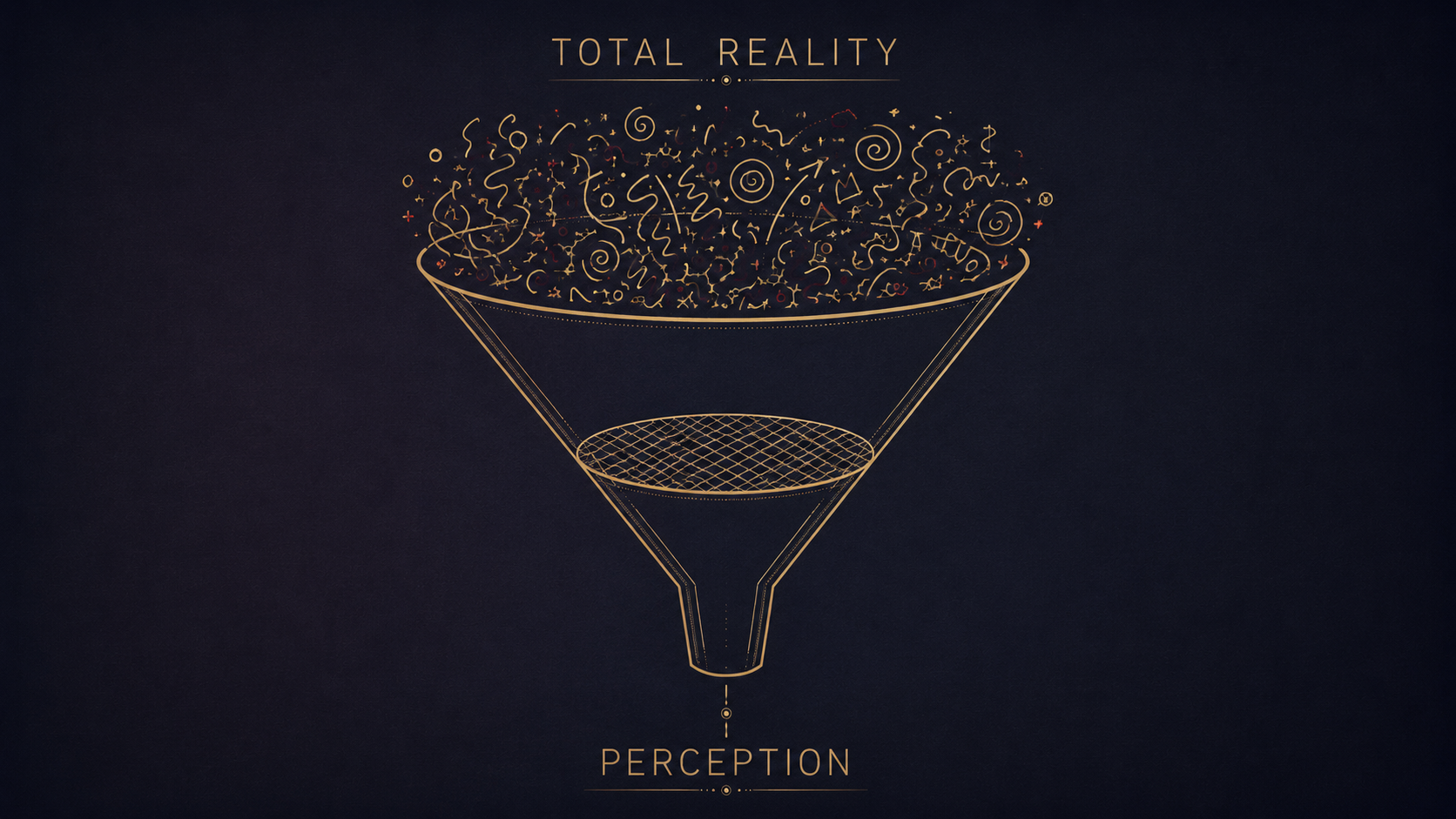
And here's the problem: you think your 10% is The Truth.
Dave assumes I see the line inefficiency and I'm choosing to be useless. I assume Dave sees the hilarity of the shoe ritual and he's choosing to be a buzzkill.
We're both wrong.
Dave is not ignoring the metaphor. He literally didn't receive it. It got deleted before it reached his awareness.
I'm not ignoring the clock. It got filtered out somewhere between my retinas and my conscious mind. Eighteen minutes could be three hours for all my system cares.
We're not watching the same movie and disagreeing about the plot. We're watching different movies and arguing about which one is playing.
Why Evolution Did This
You might wonder: why can't I just see everything? Be efficient AND abstract AND detail-oriented all at once?
Because your brain is expensive.
It's about 2% of your body mass burning about 20% of your energy. Running a high-fidelity simulation of Roman centurion history takes massive resources. Running a high-fidelity simulation of line throughput optimization also takes massive resources.
Try to run both at maximum voltage simultaneously and you crash.
So evolution didn't try to build one perfect human who could do everything. It built a distributed system.
Think of humanity as a single organism made of specialized parts. The tribe needs someone scanning the horizon for immediate threats. Someone willing to ignore tradition and invent a better tool. Someone noticing the group is about to tear itself apart and smoothing things over.
If everyone runs the same filter, the tribe dies. All pattern-recognition, no execution? We starve with a beautiful theory about agriculture. All execution, no pattern-recognition? We efficiently optimize ourselves into an ambush.
Your blind spots aren't bugs. They're features. They create the necessity for other people.
The problem is nobody sent us the memo.
So instead of seeing Dave as The Execution Node Who Handles Logistics So I Can Think About Centurions, I see him as a stress magnet who can't appreciate absurdity.
And he sees me as the guy who's going to make us miss the flight.
A quick caveat before we move on. "Different movies" doesn't mean all movies are equally accurate. Sometimes one movie is a documentary and the other is a hallucination. If the building is on fire, the person who smells the smoke is right, and the person contemplating the symbolism of fire is dead. Objective reality exists.
The "different movies" problem is mostly about relational and interpretive conflict - the arguments about what things mean, what matters, what should happen next. Not physics. When the facts are clear, the facts win.
The interesting part is how rarely the facts are what people are actually fighting about.
The Four Filters
I'm going to walk you through four fundamental ways a brain can filter reality.
These aren't the only ways to carve it up - but they're the ones that matter most. Enough to start recognizing which filter is your home base and which ones belong to the people who confuse you.
One of these will feel like water to a fish. So familiar you barely notice it's a filter at all.
The others will feel like visiting a foreign country. You can do it, but it takes effort. It's not where you live.
The Live Feed
Some brains filter for raw, uncompressed, high-definition physical reality.
If this is you: the world is loud, bright, immediate. You're not interpreting or comparing or projecting - you're receiving. The bass vibrating in your chest. The light hitting that wine glass at a specific angle. The smell of burnt garlic, acrid and particular. That guy's cologne arrived three seconds before he did.
This is kinetic intelligence. Your system is rendering reality at a higher frame rate than everyone else in the room. An athlete reading the spin of a ball before their conscious mind clocks it. An ER doctor whose hands are already moving toward the right instrument because their body registered the bleed pattern faster than language can name it. A chef who adjusts the heat a half-second before the butter burns.
This isn't "just" physical awareness. It's physics processing - trajectory, momentum, timing - running below the speed of conscious thought.
Your body is porous to the world. Sensation doesn't stop at your skin - it moves through you. A loud noise isn't just heard, it's felt in the sternum. Temperature changes register before you consciously notice them. You're not thinking about the room. You're in the room, the way a fish is in water.
You're the only person actually here. While everyone else is floating around in their heads - running simulations, consulting memories, chasing abstractions - you're tracking the live physics of what's actually happening. You react faster than anyone because you're not running the data through layers of interpretation first.
The blind spot: implication. You see the tree bark with perfect clarity and miss that you're standing in a forest that's slowly catching fire. Where is this going? What does this mean? That's not your native question.
The Archive
Some brains filter for difference-from-known-good.
If this is you: reality comes with an overlay. You see the room, but you feel whether it matches your internal library. This sauce tastes thinner than mom's - and the wrongness registers somewhere in the back of your throat before you've consciously compared them. The air pressure in here is off; your sinuses know it.
This is stabilizing intelligence. You are the structural engineer who prevents the bridge from collapsing because you remember the stress fractures from 1998. The senior nurse who catches the dosage error because something about that number doesn't feel like the right number - and she's right, because her body has filed ten thousand correct dosages and this one doesn't match. The mechanic who hears the engine and knows it's the timing belt, not because he ran a diagnostic, but because he's heard that exact sound before and his nervous system indexed it.
The body keeps the library. Comfort and discomfort aren't just preferences - they're the Archive's filing system. A chair that's wrong sits wrong - not in your opinion, in your lower back. A room that's been rearranged since your last visit creates a low hum of unease before you've consciously clocked what moved. The sorting happens through sensation, not reasoning.
And this isn't only about detecting threats. There's a deep, quiet satisfaction when the match is right - when the song sounds exactly the way you remember, when the recipe turns out the way it's supposed to, when you return to a place and find it unchanged. That's the Archive at rest. Not scanning for danger. Just... home.
This is load-bearing pattern recognition. Without it, every generation would start from scratch. Every mistake would be new. Every bridge would be experimental.
You're the guardian of what works. You notice when things degrade. You remember the details everyone else forgets. You prevent the tribe from repeating disasters because you actually tracked what happened last time. That's not resistance to change. That's the immune system of institutional knowledge.
The blind spot: the rewrite. You trust your stored impressions so deeply that new data struggles to update them. If the experience doesn't match the map, your system assumes the experience is wrong. Not the map.
The Web
Some brains filter for "this implies that."
If this is you: you look at a candle but you don't see a candle. You see fire → Prometheus → technology theft → AI ethics → you forgot to buy batteries. The object itself is boring. The cluster of associations radiating from it is fascinating.
Your attention doesn't rest. It bounces. Connecting dots nobody else sees. You're never bored because everything reminds you of something else. You're the one who says "wait, what if..." and accidentally invents something.
In the body, this feels like a kind of restless electricity. Not anxious, exactly - more like a motor that's always running. Sitting still for too long creates a buzzy, understimulated feeling in the limbs. The mind needs somewhere to go, and when it's fed - when a new connection sparks - there's a small hit of something almost physical. A little zing behind the eyes. A felt sense of "yes, that links to that".
The blind spot: the object itself. You trip over the coffee table because you were contemplating the metaphysics of wood. You look your best friend in the eye and don't actually see them - because you're busy interacting with the ten concepts their face triggered. The connection is always to the idea. Rarely to the thing.
The Telescope
Some brains filter for the singular pattern hiding behind all the noise.
If this is you: you're watching a time-lapse. Surface details blur. What remains is the archetype of the situation, the trajectory, the inevitable conclusion.
Your friend introduces you to their new partner and within three minutes you see the whole arc - the infatuation, the accommodation, the quiet resentment, the breakup conversation that will happen in about eight months. You don't know how you know. You just do. You don't see "guests arguing at a dinner party." You see the collapse of a power dynamic that was always going to happen. The host isn't stressed about the food - he's stressed because his wife is flirting with the neighbor, and this whole evening is a performance covering something neither of them wants to say.
You pierce through noise and see structural bones. You know how things end before they end.
In the body, this often feels like a kind of settling. A heaviness, almost. Where The Web buzzes outward, The Telescope pulls inward and down - into a place that feels still and certain. The knowing doesn't arrive through reasoning. It arrives whole, like a shape emerging from fog. When you're locked onto a pattern, there's a solidity in the chest. When something contradicts your vision, there's a physical resistance - a sense of no, that-doesn't-fit that you feel before you can explain why.
The blind spot: the contradicting data point. You're so locked onto the essence that you filter out evidence that doesn't fit. You might be certain the marriage is doomed while the husband says "I love my wife" five times. Your system tagged that as noise. It might not be.
Finding Your Water
Right now, you might be thinking: I do all of these.
Of course you do. You're human. You have access to all four.
But one is your default. The one that runs when you're tired, relaxed, or under pressure. The one you don't have to try to use.
Here's how to catch it:
If you have to work to notice raw physical details, The Live Feed isn't home.
If you have to work to see what a candle has to do with Prometheus, The Web isn't home.
If you have to work to remember how things were done before, The Archive isn't home.
If you have to work to see the underlying pattern instead of getting lost in surface data, The Telescope isn't home.
Your filter isn't what you can do.
It's what you can't stop doing.
Full disclosure: my filter is The Web. I live there. The centurion thing at the airport? That's the Web doing its job. One input, seventeen outputs, none of them useful for catching a flight. Every book is written through a lens, including this one. You deserve to know which movie I'm watching.
Why This Matters For Relationships
Here's the payoff for all this perception theory:
Most relationship friction is just two filters screaming past each other.
Let's say you run The Web - infinite possibility, everything connects to everything. And you're married to someone running The Archive - stability, precedent, how things have been done.
You say: "Let's drive to the coast tonight. We can sleep in the car and watch the sunrise."
They say: "We have work tomorrow. The car needs an oil change. We tried spontaneity in 2019 and it didn't work."
You think they're a joyless prison warden.
They think you're a reckless child.
And you're both wrong.
You're not disagreeing about the coast. You're running different filters. Your brain is deleting the work schedule as noise. Their brain is deleting the sunrise connection as noise.
Neither of you is being difficult on purpose. You're both just watching your own movie.
Now watch what happens when you have the map.
You stop trying to convince them the coast is a good idea. You start asking: what would help their Archive feel safe enough to consider this? What precedent could we establish? What stability could we preserve?
And they stop trying to convince you to be realistic. They start asking: what is this actually about? What possibility does the coast represent? What is the Web really chasing?
You can work with filters.
You can't work with "my spouse is fundamentally unreasonable."
What We Haven't Covered
We've now mapped how brains delete reality differently. The filter. The lens.
But perception is only half the equation.
Two people can run the exact same filter and still make completely different decisions about what they're perceiving.
That's because once data gets through the filter, it still has to be evaluated. Weighed. Judged.
And your brain has a very specific, very biased algorithm for that part too.
It's called your Compass. And you probably think it's just "common sense."
It isn't.