Introduction
The Documentation Nobody Gave You
Let's be honest for a second.
Most of the friction in your life - the recurring fights with your partner, the coworker you're half-convinced is just pretending to be a real person, the reason you keep burning out in the exact same way despite swearing you wouldn't - usually boils down to one simple, irritating fact.
You think everyone else is running the same operating system as you.
You think when you say "let's make a plan," other people hear what you hear. You assume "being reasonable" means the same thing to your boss as it does to you. You assume when someone ignores a glaring logical contradiction, they're doing it on purpose.
Probably just to piss you off.
They aren't.
They are literally, biologically, running different software.
And because nobody ever gave you the documentation for their build - or yours, for that matter - you're stuck guessing. You're trying to run high-end graphics on a spreadsheet processor. You're inputting logic into a machine that runs entirely on feelings and weather patterns.
The result is a mess. Confusion. Judgment. Years of therapy trying to fix "communication issues" that were actually hardware incompatibilities.
This book is the documentation.
Not so you can fix everyone. Not so you can win arguments or finally prove that you were right all along. So you can stop being blindsided by the people in your life - your partner, your boss, your parents, yourself. So the fights that keep happening the same way start making sense. So you can stop burning out on the same patterns and actually build something different. So you understand why you keep getting stuck - and what it would take to get unstuck.
We're going to treat human psychology as a set of mechanical dials. Not a mystical journey. Not a collection of cute "traits." Not a horoscope with better vocabulary.
Dials. Variables. Things you can actually read.
I call it Human Math.
There are five variables that determine why a person does what they do:
The Cognitive Dial: What their brain pays attention to and how it decides what matters.
The Safety Dial: What their nervous system thinks "danger" looks like.
The Attachment Dial: How they handle intimacy and distance.
The Values Dial: The complexity of the world they can actually process.
The State Dial: How much bandwidth they have right now.
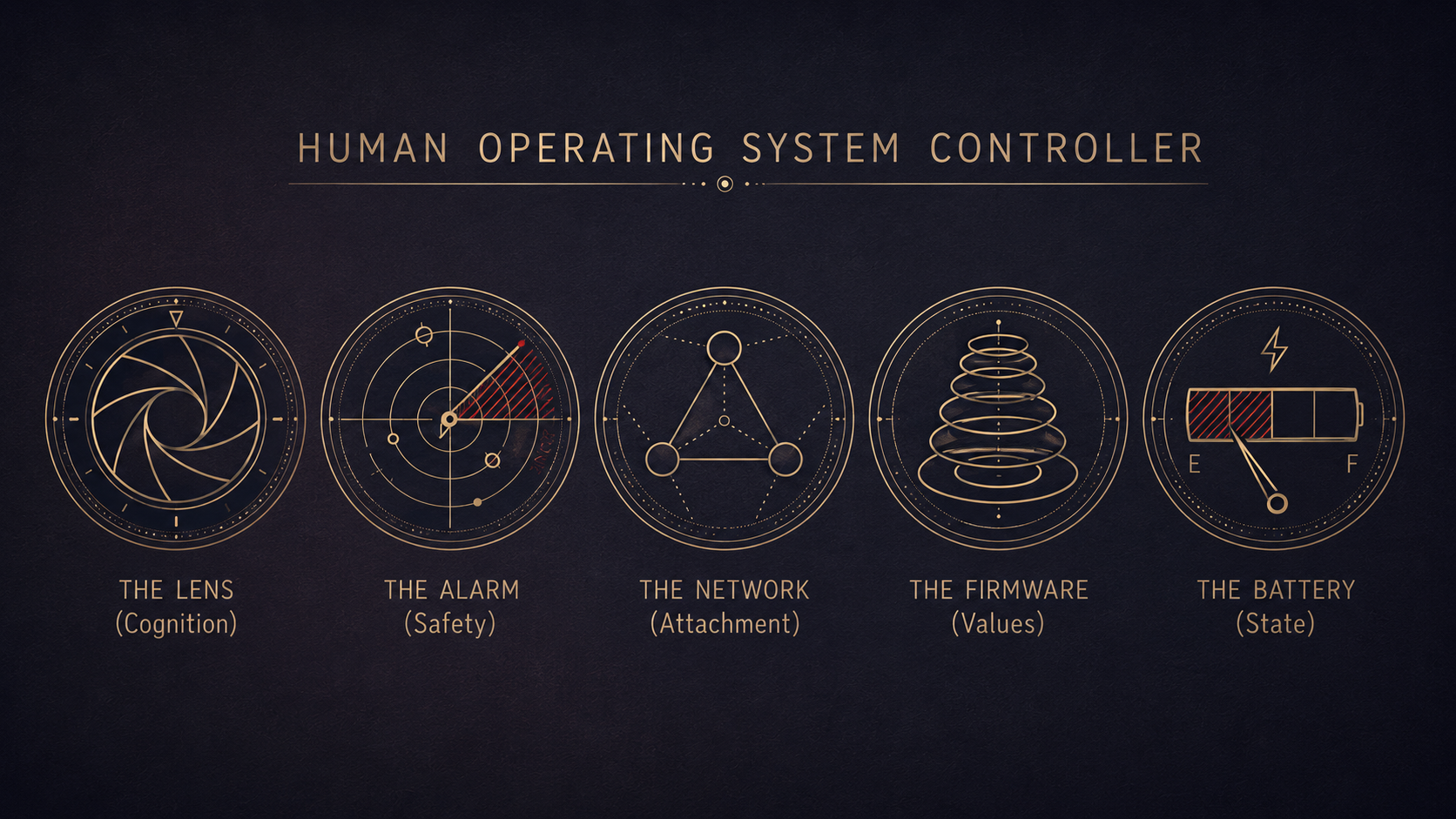
When you can read these dials, human behavior stops looking random.
It becomes predictable. Sometimes uncomfortably so. Sometimes you'll watch someone walk into the same trap for the fifteenth time and think "yeah, that's exactly what their configuration would do."
You'll also watch yourself walk into your own traps. With full awareness. Unable to stop.
We'll get to that.
But before we touch a single dial, we need to introduce the guy guarding the control panel.
Meet Barry
We need to talk about your ego.
Not the "I'm the greatest" kind of arrogance. I mean the frantic, invisible middle-manager in your head whose only job is to make sure you don't get kicked out of the tribe and die alone in the woods.
I call him Barry.
Barry is hardworking. Barry is stressed. Barry has a clipboard and a headset and he is constantly screaming at your cognitive systems to keep it together.
When you get defensive because someone corrected your grammar? That's Barry assuming that being wrong equals loss of status equals death.
When you refuse to ask for help even though you're drowning? Barry, convinced that independence equals safety.
When you spiritually bypass your actual feelings by posting a thoughtful caption about "integration"? That's Barry wearing a yoga outfit.
Barry isn't evil. He's trying to protect you. The problem is that his threat-detection was calibrated when you were four years old and your primary concern was whether mom was mad at you.
He hasn't updated his playbook since.
We're going to talk about Barry a lot. We have to. Because you can learn all the fancy models in the world, but if Barry feels threatened, he will just weaponize them to make you more insufferable.
I've watched it happen. I've done it myself. I've used psychological frameworks to win arguments with people I claimed to love, all while Barry whispered that I was just "being accurate."
Our goal isn't to kill Barry. That's just more ego with a different hat.
Our goal is to get him to sit down, take a breath, and let the adults drive.
What We're Covering
This book moves through the five dials in order.
Part One is the Cognitive Dial - the deepest layer. This is where we learn that your brain is deleting 90% of reality before you even have a conscious thought. The 10% that survives isn't "the truth." It's just what your particular hardware decided was worth keeping.
Part Two is the Safety Dial. This is where we meet your nervous system - not the thing that makes your hands shake before a presentation, but the deeper layer that decides what counts as danger before your conscious mind gets a vote. This explains why two people with identical cognitive wiring can behave like completely different species. Same tools, different survival mission.
Part Three is the Attachment Dial - what happens when another human gets close enough to matter. This is where smart people become absolute idiots. Where your carefully developed self-awareness goes out the window because someone you're attracted to didn't text back fast enough.
Part Four is the Values Dial - how far your sense of "we" extends into the world. This one makes people uncomfortable because it implies some people can process more complexity than others. They can. We'll talk about why that's not a moral judgment and why it matters anyway.
Part Five is the State Dial - how all of the above gets warped by sleep, stress, hormones, and whether you've eaten in the last six hours.
Part Six is about using all of this without becoming the person everyone hates at parties. This is where we talk about integration - how to hold these models lightly, deploy them without weaponizing them, and stay human while seeing the machinery.
A note on scope: this book gives you the architecture. The operating system logic. Companion volumes will walk through every configuration in detail. Think of this as the theory. Those are the field guides.
For now, I just need you to understand how the dials work and how they interact. The specifics come later.
The Deal
Before we go any further, we need to agree on some ground rules.
If you skip this section, there's a non-zero chance this book turns you into a more sophisticated version of exactly the kind of person it's trying to help you understand.
I don't want that liability. And honestly, neither do you.
So. The Epistemic Contract. Read it. It's short.
Then we'll get to the actual machinery.
The Epistemic Contract
This isn't legal boilerplate. It's a genuine attempt to prevent you from using this book to make yourself worse.
The failure mode is predictable. You learn a framework, you get excited, and suddenly you're explaining to your crying partner that they're "only reacting this way because of their anxious attachment and cognitive loop."
You feel very smart in that moment.
You are also being an asshole.
So. The contract. Eight clauses.
1. Models Are Maps, Not Territory
The frameworks in this book - cognitive functions, the Enneagram, attachment styles, developmental levels - are not metaphysical truths.
They are compression algorithms.
Useful lies. Deliberate simplifications of something so complex that tracking every variable would melt your brain.
We use them because they work, not because they're holy.
The moment you forget that distinction, you've traded one set of handcuffs for a fancier pair. Shinier. More intellectual. Still handcuffs.
2. Hierarchy Exists
This is the one that makes people squirm.
We're going to talk about developmental levels. We're going to use numbers. And yes, Level 5 consciousness can process things that Level 3 consciousness structurally cannot.
That's not a moral judgment. It's not even about intelligence.
Think of it as visual range. A person operating at Level 5 can see global systems, long-term consequences, the way an entire culture's assumptions are shaping a conversation. A person at Level 2 might not see any of that - but they can see the person standing in front of them who needs help right now. Clearly. Without overthinking it. Without needing to build a theory about suffering first.
Higher levels see more of the map. They don't automatically navigate better.
A healthy person at a "lower" level who actually shows up for people will do more good in the world than a dysfunctional person at a "higher" level who can critique every system in sight but can't hold a job or return a phone call. We'll meet both later.
Complexity of processing is real. Hierarchy of human worth is not. If you walk away from this book ranking people, you've missed the point entirely.
If you're allergic to this idea, notice the allergy. That's Barry, protecting you from the possibility that someone might be further along than you - or that you might be further along than someone you love.
Both are uncomfortable. Both might be true.
3. No Weaponization
You will see your spouse in this book. You will see your parents. You will see your ex, your coworker, and that one friend who always does That Thing.
You are strictly forbidden from using this terminology to win arguments.
"You're only saying that because you're a harmony-seeker with an avoidant attachment style" is grounds for having this book confiscated.
I'm serious.
You're allowed to use it to understand why you keep ending up in the same fights. You're not allowed to use it as ammunition within those fights.
The distinction is everything. One is curiosity. The other is Barry wearing a therapist costume.
And while we're here: if someone uses this language on you - if a partner diagnoses you mid-fight, dismisses your feelings as "just a loop," or waves away your dissent as a "level limitation" - that is not insight.
That is abuse wearing a vocabulary upgrade.
Frameworks used to shut someone down rather than open something up have left the building of understanding entirely. If it's happening to you, name it. If you catch yourself doing it, stop.
4. Failure Modes Are Included
Every model in this book breaks eventually. We'll point out exactly where.
If a framework claims to explain everything, it's bullshit. The useful question isn't "is this true?" It's "what does this compress well, and where does it start lying?"
We'll name the lies. We'll name my lies. We'll name the places where I suspect I might be lying but can't quite catch myself at it yet. The goal is usefulness, not faith.
One known limitation worth naming upfront: these models were not designed with neurodivergent variation in mind. ADHD can mimic certain cognitive function expressions. Autism can interact with how someone processes logic versus emotion in ways that complicate typing. Somatic descriptions throughout this book may not map cleanly onto neurodivergent experience. This doesn't make the models useless for neurodivergent readers - but it means the map has extra distortion in those regions, and you should hold it accordingly.
5. Your Experience Is Data
If the map says you should do X, but you consistently do Y, that's not you being broken.
That's information.
Either the model is incomplete, or you're misapplying it, or Barry is interfering, or this is genuinely one of the places where the framework fails.
All four are interesting. None of them require you to gaslight yourself into fitting the theory.
I've watched people do that. Twist themselves into knots trying to match a type description because they liked the sound of it. It's sad. Don't do it.
6. This Isn't Astrology
Naval Ravikant once tweeted that Myers-Briggs is "astrology for the mildly educated class."
As a critique of how most people use personality models online? Not wrong. Most type content you see on TikTok, Reddit, and corporate trainings fits the pattern: fuzzy categories, cherry-picked examples, flattering descriptions, zero falsification criteria. "These types are masterminds." "Those types are chaos gremlins." It's horoscopes with different fonts.
But people see the cringe users and conclude the entire idea of stable cognitive patterns is bullshit. That's like watching bad stock-picking gurus on YouTube and deciding finance is fake.
The actual difference: Astrology claims a star millions of miles away decided your personality. This book claims your neurobiology, developmental history, and survival learning decided your personality - and that those patterns are observable, predictable, and useful to understand.
One requires faith. The other requires observation.
But I'll give the skeptics one more thing, because they've earned it.
When you have five dials to play with, there's a real risk of explaining everything after the fact. Someone does something your read didn't predict? Just adjust the State Dial. Still doesn't fit? Must be their attachment style kicking in. You can always find a knob to turn after the fact to make the model "explain" what just happened.
That's not prediction. That's a horoscope with more moving parts.
This is the single most important thing to watch for in yourself as you read this book.
The check against it is pattern consistency. If your read of someone requires you to move the dials every five minutes to explain their behavior, your map is wrong. Or you're reading it wrong. Either way, stop.
A good read should be stable. It should predict what someone does next, not just explain what they already did. If it can't do that, it's not a model. It's a story you're telling yourself.
If you can't see the difference, that's fine. This book probably isn't for you.
7. Humor Is A Safety Feature
We're going to laugh at this stuff. We have to.
The moment you take it too seriously, you start identifying with the labels. And once you identify with the labels, you're cooked. Barry has won. The map has become the territory and you've built your entire sense of self inside a compression algorithm.
I've watched people do this in real time. They learn they're a "Type Four" and suddenly every emotion becomes evidence of their profound depth. They learn they're an "INTJ" and suddenly every disagreement proves they're surrounded by idiots.
The framework was supposed to create distance from the pattern. Instead it became the pattern's new costume.
If you can't laugh at your own wiring, you don't understand it yet.
You're just wearing it more proudly.
8. There's Something Watching
This book maps the wiring. The dials, the loops, the survival strategies your nervous system installed before you could spell your own name.
But here's the thing: there's something aware of the wiring.
The "you" that notices Barry is not Barry. The "you" that watches your own patterns fire and thinks "ah, there it is again" - that isn't a pattern. Or if it is, it's a different kind entirely.
I'm not going to name it. I'm not going to call it your soul, your higher self, or your true nature. Partly because those words come with luggage. Partly because the moment you label it, Barry will try to claim it as another achievement.
But I want you to know that this book's mechanical framing has a deliberate hole in it. The dials explain a lot. They don't explain the thing looking at the dials.
I don't know what that is. I don't think anyone does.
I just didn't want to build you an entire cockpit and pretend there's no pilot.
Those are the rules.
Violate them at your own risk. And at the risk of everyone who has to be in relationship with you.
Now - before we get to the machinery itself, you should probably know whose brain you're borrowing.
About The Author (As Guinea Pig)
You're about to spend a lot of time inside someone else's head. You should probably know whose.
My name is Will.
My brain craves internal logical coherence the way some people crave approval. When something contradicts something else I thought I understood, it becomes a physical itch I can't ignore until I resolve it.
My nervous system is convinced that my worth as a human being is directly proportional to my demonstrated competence. If I'm not understanding something deeply - and proving that I understand it - Barry starts screaming that the floor is about to drop out.
Put those together and you get: a person who achieves safety by understanding things really, really well. Who has been running a longitudinal study on his own psyche for fifteen years. Who finds the machinery so intrinsically interesting that he couldn't stop pulling it apart if he tried.
This book is a symptom of my configuration. I'm not writing it because I've transcended my patterns. I'm writing it because my patterns pointed me here and I followed them.
There's a reason I can describe what different configurations feel like from the inside - not just my own. It's a weird story involving a lot of mushroom trips and what amount to accidental experiments on my own cognition. I'll tell it properly in Chapter 7, when you have enough context for it to land as methodology rather than mysticism.
For now, just know that the access is experiential, not theoretical. I haven't just read about this stuff. I've been inside it.
The Self-Deception Problem
Here's where Barry would really like me to stop writing.
My configuration is specifically prone to disguising ego as insight. Achieving competence to prove I exist is my game. A book about psychological understanding is exactly what Barry would push me to write - and then congratulate me for being so honest about it.
I'll flag it when I catch it. I'll miss it sometimes.
For now: my motivations are mixed, like everyone's. That's all I can offer. Whether it's enough is something you'll decide for yourself.
Why This Book
I'm writing this because I looked for it and it doesn't exist. Plenty of personality books out there, but none that hold multiple models simultaneously while treating cognition as lived texture rather than behavioral checklist - without wrapping the whole thing in spiritual language that makes skeptics run for the hills.
The gap bothered me enough that I filled it.
How To Read Me
Throughout this book, I'm going to use myself as a case study. Not because I'm especially interesting. Because I'm the only psyche I have full access to.
At the end of this book, there's Appendix A: The Full Autopsy - an exhaustive breakdown of my entire psychological architecture across all five dials. Every pattern, every shadow, every way Barry has tried to hijack the project. I'm putting it there, not here, because you need the vocabulary first for any of it to mean anything.
Think of it as a promise: I won't ask you to dissect yourself until I've dissected myself first. Publicly. In writing. With nowhere to hide.
Alright.
Now you know whose brain you're borrowing.
Let's talk about how yours actually works.